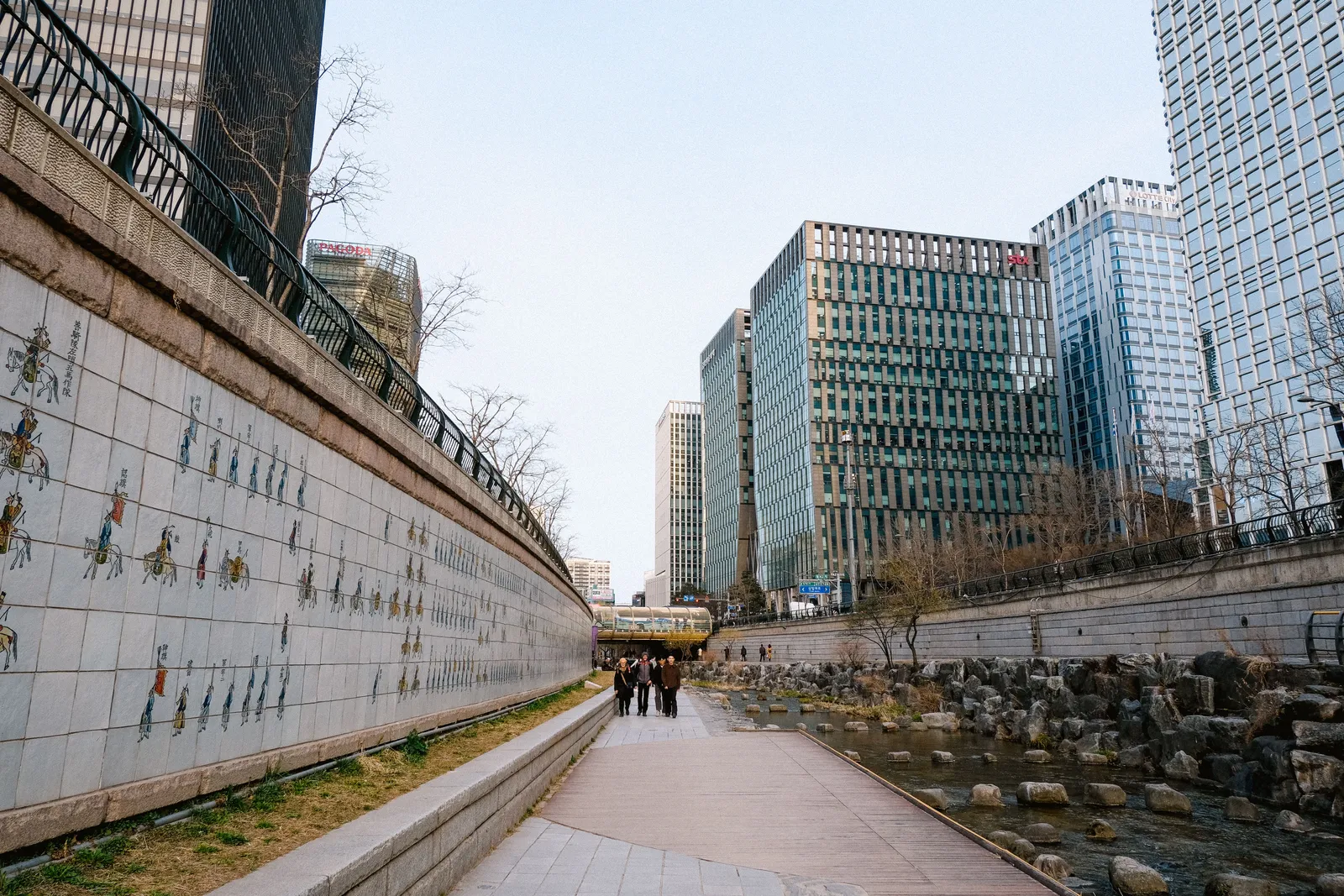
Seoul turns up in an extraordinary number of Korean dramas, and after watching a handful of them the city can start to feel oddly familiar even on a first visit: the same stone staircase, the same mural wall, the same bridge lit up at night. That repetition is not an accident. A relatively small set of streets, parks and rooftops photograph well, sit close to production offices, and let a crew shoot without shutting down an entire district, so they turn up again and again under different character names.
Interiors are usually built as sets and pulled down afterwards, murals get repainted, and a location used in one show has no guaranteed connection to another. What follows is organised by what each place actually is, a mural village, a hanok district, a hill with a tower, rather than by which series used it, because that is the part you can rely on.
Why the same handful of streets keep appearing on screen
Production companies favour locations that solve several problems at once. A steep, narrow lane with painted walls gives a director texture and colour without a set budget. A hanok district supplies instant period atmosphere in a city that is otherwise glass and concrete. A hill with a clear skyline view solves the problem of establishing where a story is set in a single shot. And a public riverside park photographs well at dusk without a location fee. Add in that many broadcasters sit in and around central Seoul, and the pull toward a short list of reliable, camera-friendly places rather than scouting somewhere new for every scene becomes obvious.
Ihwa Mural Village: the stairs, and why a neighbourhood pushed back
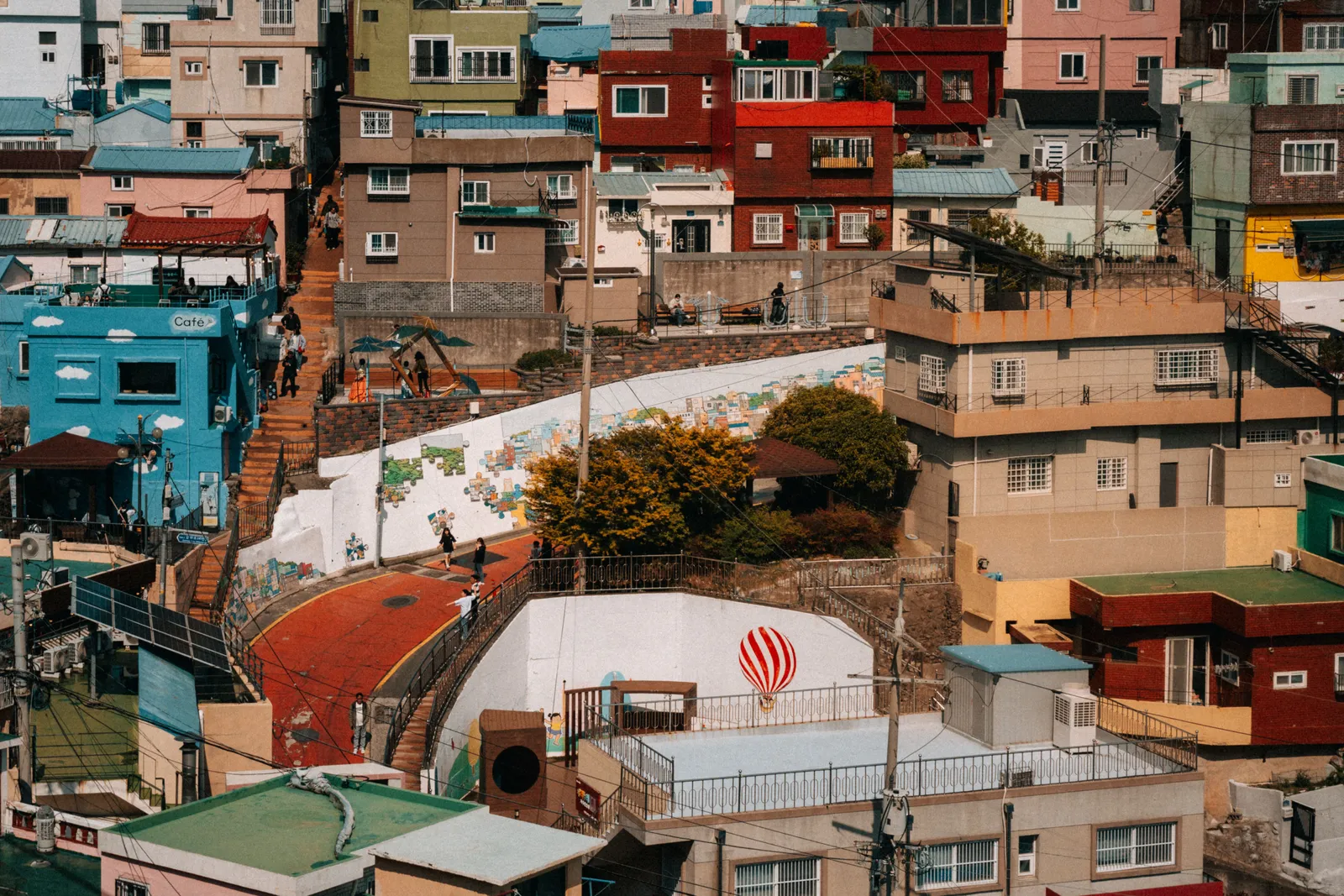
Ihwa-dong climbs the side of Naksan, one of the low hills that used to ring the old city wall, and it has become shorthand in dozens of productions for a certain kind of romantic, old-fashioned Seoul: steep stone steps, low houses stacked one above another, and murals of fish, flowers and staircases painted across walls and stair risers by an art project set up years ago to brighten a poor, ageing neighbourhood.
The catch is that Ihwa-dong is a real residential area, and the fame of a handful of murals turned a quiet hillside into a stop on nearly every Seoul day tour. Some residents, tired of tour groups on their doorstep, painted over sections of the artwork themselves in past years, and murals shown in older photographs no longer exist in the same form. Go, but do not expect every wall from a screenshot to still be standing, and treat the steps as somebody’s front path rather than a photo backdrop.
Bukchon Hanok Village: the standard shorthand for old Seoul
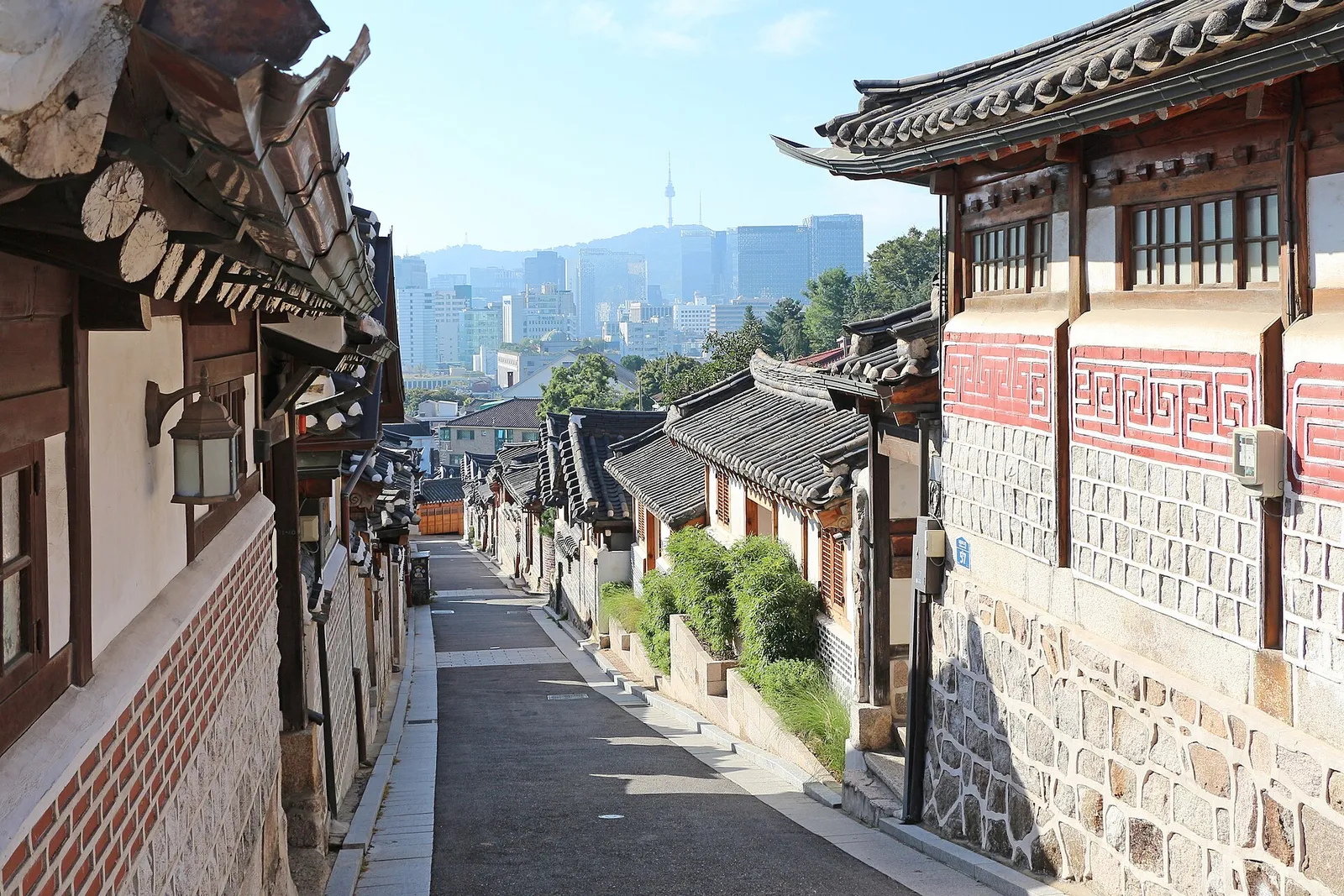
Bukchon sits on the high ground between Gyeongbokgung and Changdeokgung, two of Seoul’s grandest royal palaces, and its lanes of traditional hanok houses with curved tiled roofs are used constantly, in dramas, variety shows and endless photo shoots, as the visual signal for traditional Korea, in much the way a red telephone box signals London.
What the screen rarely shows is that Bukchon is a lived-in neighbourhood of several hundred private homes, not a museum, and the narrower residential lanes away from the main tourist street are quiet, close-set and easy to disturb with noise or a camera pointed through a gate. The most filmed lane of all, Bukchon-ro 11-gil and the streets immediately around it, is now a restricted zone that admits tourist visits between 10:00 and 17:00 only, and a tourist walking in outside those hours is liable to a fine; the signs at the entrances set the hours and the boundaries and both can change. The photogenic hanbok rental shops and viewpoints cluster around the main streets for a reason: that is where visiting is genuinely welcome.
A guided walk connects the streets a map cannotSmall-group tours link the mural village, the hanok lanes and the tower in one route, from around 30,000 wonNamsan and the padlock fence
Namsan, the forested hill at the centre of the city, and the N Seoul Tower on top of it, appear in a wide range of productions as the backdrop for a reconciliation or a rooftop confession, usually shot from the fenced terrace where couples clip padlocks engraved with their names. The cable car up, the view over the whole city, and the tower lit in changing colours after dark make it one of the most reliably cinematic spots in Seoul, and one of the busiest.
The lock fence itself is not permanent, since park management periodically clears sections that become overloaded, so a specific lock from an old photograph is unlikely to still be there. Walk or take the cable car up in the late afternoon to catch the sunset and the lights coming on without joining the busiest evening queue.
Yeonnam-dong and Seongsu-dong: the newer romance backdrop
If Ihwa and Bukchon supply the old-fashioned mood, Yeonnam-dong and Seongsu-dong supply the present-day one. Yeonnam-dong, built around a strip of green space known locally as Yeontral Park, is full of small independent cafes and low apartment blocks, and turns up as the setting for present-day romance and slice-of-life scenes: the ordinary, liveable Seoul a character comes home to rather than the kind a tourist photographs.
Seongsu-dong, once a district of shoe factories near Seoul Forest, has been converted street by street into industrial-chic cafes, concept stores and rooftop bars, and now stands in for the fashionable, creative side of the city. Both are easy to reach by metro and easy to wander for an afternoon without a map or a plan.
The Han River parks and their bridges
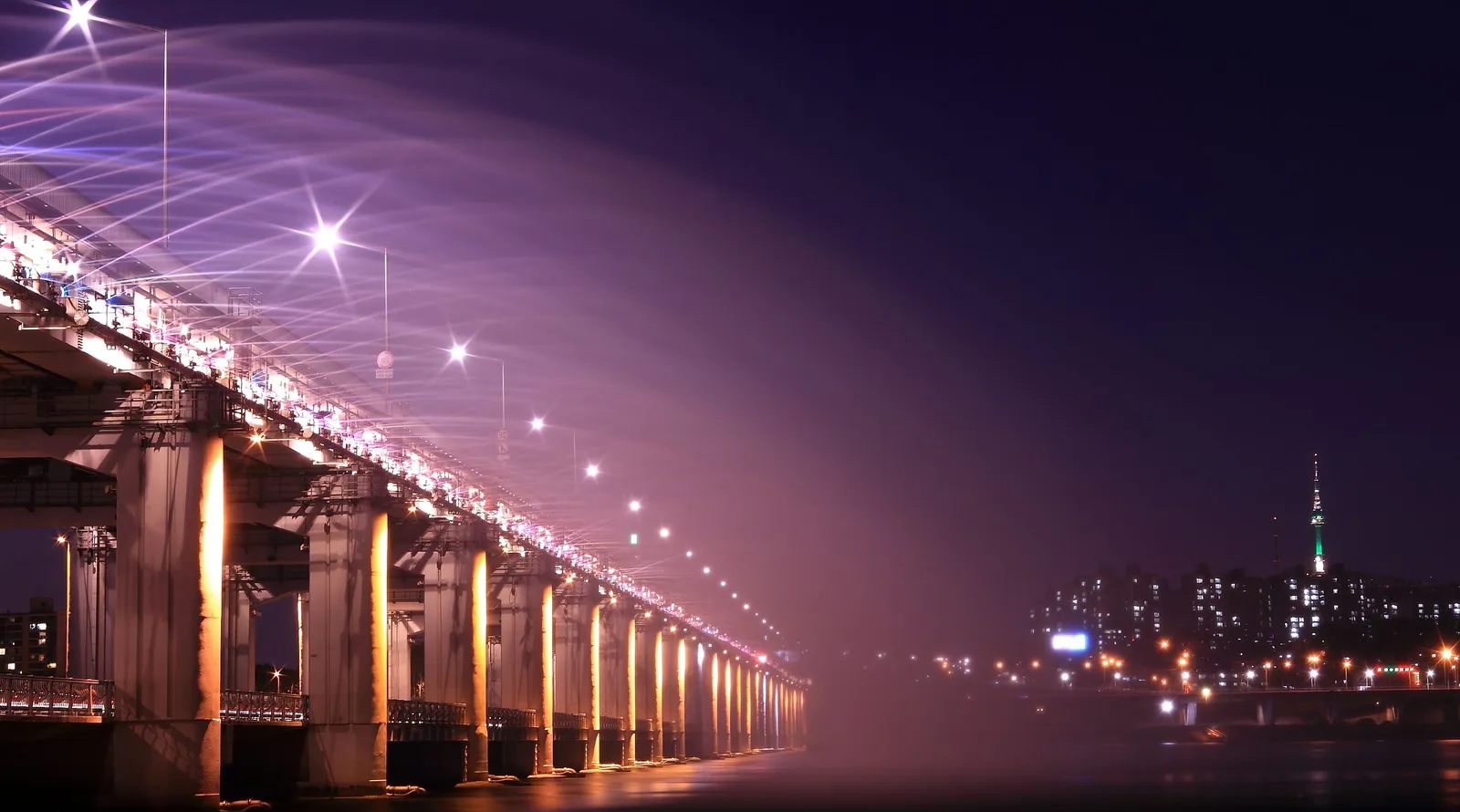
A late-night scene with two characters sharing convenience-store noodles and beer on a picnic mat, city lights behind them, is one of the most repeated images in Korean drama, and it is filmed at one of the parks that line the Han River, most often Yeouido or Banpo. The river itself, and the bridges that cross it, several lit at night and one, Banpo Bridge, built with a fountain that sprays from its sides in the warmer months, supply the water, the skyline and the light that a studio cannot fake as convincingly.
For a visitor the appeal is the same as it is for the characters on screen: a convenience store, a mat from a nearby shop, and a stretch of grass by the water, with no ticket and no booking required.
Seeing it without a tour, and how to behave
Every place in this guide is reachable by metro and on foot, with no ticket needed beyond the optional Namsan cable car. A workable route puts Ihwa Mural Village first and Bukchon after it from 10:00, when its restricted lane opens, into one unhurried morning, since both sit near the old city wall, saves Yeonnam-dong and Seongsu-dong for an afternoon of cafes, and leaves Namsan or a Han River park for an evening, when both look their best.
| Area | Best for | How to reach it |
|---|---|---|
| Ihwa Mural Village | Morning, quiet lanes | Hyehwa or Dongdaemun History and Culture Park station, then a walk uphill |
| Bukchon Hanok Village | 10:00 to 17:00 in the restricted lane | Anguk station |
| Namsan and N Seoul Tower | Sunset and evening | Myeongdong station, then cable car or footpath |
| Yeonnam-dong | Afternoon, cafes | Hongik University station |
| Seongsu-dong | Afternoon, cafes and shops | Seongsu station |
| Han River parks | Evening, picnics | Yeouinaru station for Yeouido, Express Bus Terminal for Banpo |
The single most useful habit across all of them is remembering that a filming location is somebody’s neighbourhood first. Keep noise down on residential streets, do not walk into private courtyards or point a camera through an open door or window, and give way on narrow steps to people who actually live there and are simply trying to get home.
The short version
Seoul’s most familiar drama backdrops are a short, walkable list: Ihwa Mural Village and Bukchon for the traditional look, Namsan for the big romantic set piece, Yeonnam-dong and Seongsu-dong for the modern one, and the Han River parks for the late-night picnic shot. All of them are free to visit and reachable by metro. Treat specific drama claims with scepticism, since sets change and murals get repainted, and treat every one of these places as a real neighbourhood rather than a stage. For more of the city around them, our guide to Seoul covers the neighbourhoods in full, our guide to K-pop for travellers covers the music side of the same culture, and our Seoul day trips guide covers filming-adjacent spots outside the city.